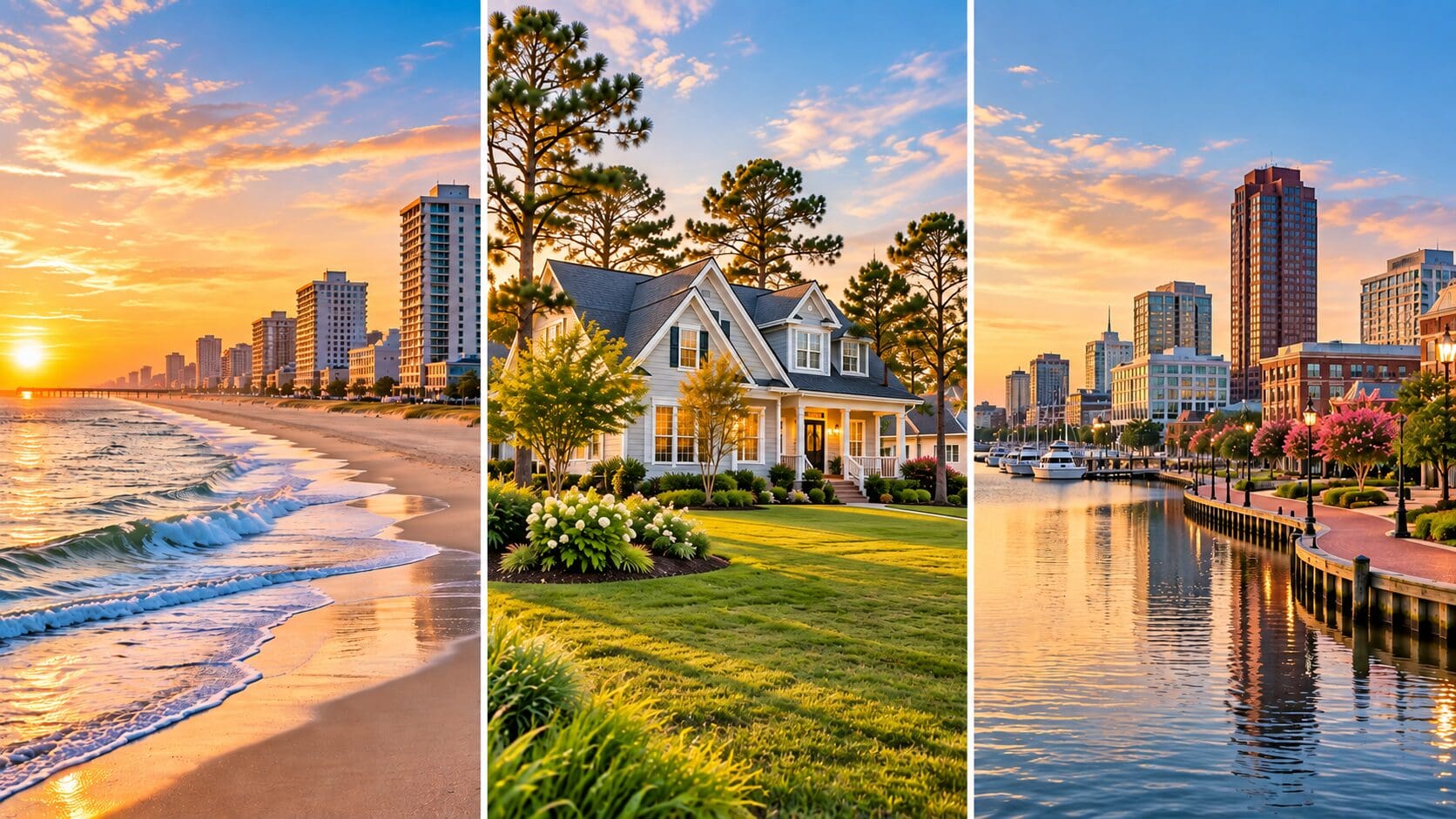
Virginia Beach vs. Chesapeake vs. Norfolk: How Do the Housing Markets Compare?
If you’re considering a move within Coastal Virginia, you’ve probably found yourself comparing Virginia Beach, Chesapeake, and Norfolk.
And that’s a good thing.
These three cities are close geographically, but their housing markets can look surprisingly different.
You’ll find different housing styles, different property ages, different lot sizes, different price points, and different considerations when it comes to things like taxes, HOA fees, flood exposure, and maintenance.
Rather than trying to decide which city is “better,” I think it’s much more helpful to understand what the housing market looks like in each one and then decide which characteristics fit what you’re looking for.
Here’s a closer look.
Virginia Beach
Virginia Beach has one of the most varied housing markets in Coastal Virginia.
That’s partly because the city covers such a large geographic area.
Depending on where you’re looking, you may find:
- Older established homes
- Newer construction
- Townhomes
- Condos
- Larger homesites
- Homes near the ocean or bay
- Properties farther inland
- A wide range of architectural styles
Because of that variety, two homes in Virginia Beach can have very different price points and ownership considerations even when they’re listed for similar amounts.
For example, a home closer to the water may offer less square footage than a similar-priced home farther inland.
An older home may offer more character and a larger lot but require more attention to maintenance.
A newer home may offer modern finishes and newer systems but come with HOA requirements or other ongoing costs.
The key is to compare the actual properties—not just the city name attached to the listing.
Chesapeake
Chesapeake has its own mix of established neighborhoods, newer construction, townhomes, and properties with larger lots.
One of the things you’ll notice when looking at Chesapeake real estate is how much the housing stock can vary from one part of the city to another.
You may encounter newer homes with modern floor plans alongside older properties with mature landscaping and established trees.
Lot size can also vary significantly.
For buyers who are comparing properties, it’s worth paying attention to the relationship between the house, the lot, and the surrounding development.
A larger property isn’t necessarily the better value, and a newer home isn’t automatically the better choice.
It comes down to what you’re purchasing and what you’ll be responsible for maintaining after closing.
Norfolk
Norfolk offers something a little different from the other two cities.
Its housing stock includes a significant number of older homes, historic properties, traditional neighborhoods, condos, townhomes, and newer construction.
If you appreciate architecture and older homes, there is plenty to notice here.
You can find beautiful details such as:
- Original hardwood floors
- Detailed trim work
- Brick fireplaces
- Older windows
- Front porches
- Distinctive architectural styles
- Mature landscaping
Of course, character often comes with age.
When you’re considering an older home, I recommend paying particular attention to the condition and age of the major systems.
The charm may be what gets you through the front door, but the roof, HVAC, plumbing, electrical, foundation, and other major components are what you’ll want to understand before making a decision.
What About Home Prices?
This is where I think buyers can get themselves into trouble by relying too heavily on broad citywide averages.
A city can have a wide range of home prices.
The value of an individual property depends on many factors, including:
- Location
- Lot size
- Square footage
- Property age
- Condition
- Renovations
- Construction quality
- Architectural style
- Garage or parking
- Outdoor features
- HOA or condominium fees
- Flood zone
- Recent comparable sales
So if you’re comparing a $500,000 home in Virginia Beach with a $500,000 home in Chesapeake or Norfolk, don’t assume you’re comparing three identical products.
You’re not.
You’re comparing three individual properties within three very different housing markets.
Don’t Forget Property Taxes and HOA Fees
The purchase price isn’t the only number worth comparing.
Before you decide what a home will actually cost you each month, take a look at:
- Property taxes
- Homeowners insurance
- Flood insurance, when applicable
- HOA fees
- Condominium fees
- Utilities
- Expected maintenance
- Potential upcoming repairs
These expenses can make a meaningful difference in the overall cost of owning a home.
That’s why I always encourage buyers to look at the complete financial picture rather than focusing only on the list price.
Coastal Virginia Means Paying Attention to Water
This is one area where buyers should be particularly thoughtful.
Being in Coastal Virginia means water, drainage, storms, and flood considerations are part of the real estate conversation.
That doesn’t mean every property has the same level of risk or requires flood insurance.
It does mean you should investigate the individual property.
When you’re considering a home, look at:
- Current flood zone information
- Elevation
- Drainage
- Previous water intrusion
- Crawl space or foundation conditions
- Insurance requirements
- Flood insurance costs, when applicable
Don’t assume that a property is or isn’t affected by flooding simply because of its city or its distance from the water.
The individual property matters.
Older Home or Newer Home?
This is another important comparison when you’re looking at these three cities.
Older homes can offer character, mature landscaping, established streetscapes, and architectural details that aren’t always found in new construction.
Newer homes may offer newer systems, modern floor plans, energy-efficient features, and fewer immediate maintenance concerns.
Neither is automatically better.
The question is what you’re comfortable taking on.
If you love an older home, make sure you understand its condition.
If you prefer newer construction, make sure you understand the builder, warranties, HOA requirements, lot characteristics, and any additional costs associated with the property.
Look at the Actual Home, Not Just the City
One of my favorite parts of working in Coastal Virginia is that you don’t have to put every property into a neat little box.
There are beautiful homes in all three cities.
There are older homes that have been thoughtfully maintained.
There are newer homes with wonderful layouts.
There are homes with large yards and homes with very little exterior maintenance.
There are properties near the water and properties farther inland.
There are condos, townhomes, single-family homes, and everything in between.
That’s why I encourage buyers to start with the characteristics that matter to them and then compare properties objectively.
Instead of asking:
“Which city is best?”
Try asking:
“What does this particular property offer, and does it make sense for me?”
That shift can make the home search much less overwhelming.
A Few Questions to Ask When Comparing Homes
When you’re looking at properties across Virginia Beach, Chesapeake, and Norfolk, I recommend keeping a running list of questions.
For each home, consider:
- What is the age of the home?
- How old are the roof and HVAC?
- What major renovations have been completed?
- Were permits obtained when required?
- What are the annual property taxes?
- Is there an HOA?
- Are there condominium fees?
- What does the HOA cover?
- Is the property in a flood zone?
- What are the insurance considerations?
- How large is the lot?
- How much maintenance will the property require?
- What are the recent comparable sales?
- What repairs or improvements might be needed in the next few years?
Once you start comparing homes this way, the differences become much easier to see.
The Bottom Line
Virginia Beach, Chesapeake, and Norfolk each offer a wide range of housing options.
The important thing isn’t finding a universal answer to which city is “best.”
It’s understanding the characteristics of the homes you’re considering and comparing the things that actually affect your purchase and your ownership experience.
Price is important.
But so are condition, location, lot size, taxes, insurance, flood considerations, maintenance, HOA fees, and the way the home functions for your everyday life.
That’s where good information becomes really valuable.
If you’re comparing homes across Coastal Virginia, I’m always happy to help you look at the numbers, the property details, and the bigger picture so you can make an informed decision without feeling pressured.
Sometimes the best decision isn’t about choosing a city first.
It’s about finding the right property within your budget and understanding exactly what you’re buying.


PLEASE COMMENT BELOW